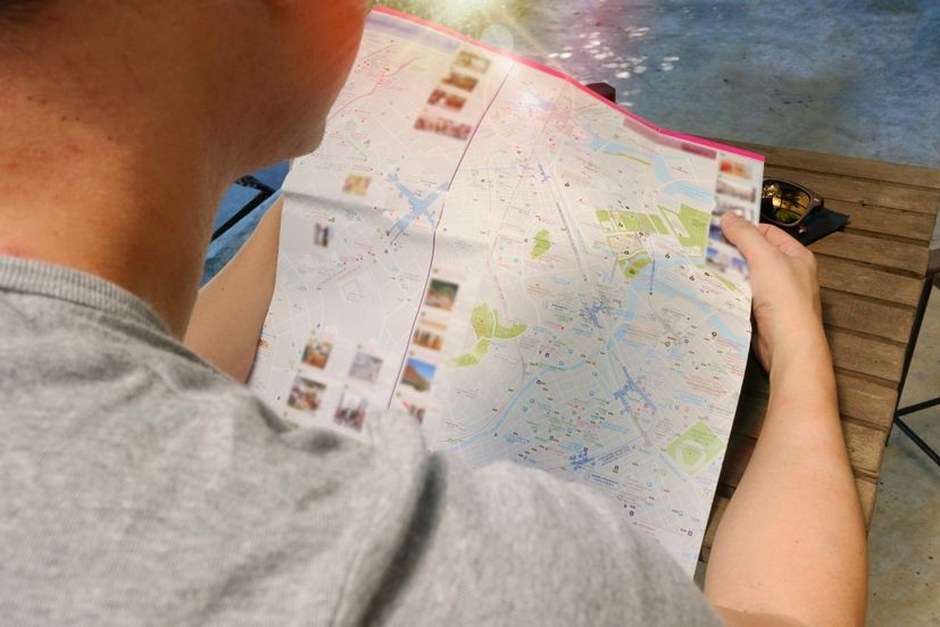
A full list of sights can make a city feel strangely small. You spend the day moving from pin to pin, looking at the map whenever the street becomes interesting, and measuring success by how many places were completed. A better walking day needs some structure, but not much.
Pick two anchors, not twelve stops
Choose one place for the first half of the day and one for the second: a market and a museum, a park and a neighborhood square, a piece of architecture and a riverside path. The anchors create direction without dictating every turn between them.
Before leaving, look at the rough distance rather than the exact route. If the walk is comfortably manageable, let the streets connect the points for you. Keep transit as an option for the return, especially if the city is hilly or the weather is uncertain.
Build in a slow middle
The best part of a walking day is often the hour that was not assigned a purpose. Leave enough time around lunch to sit somewhere, browse a bookshop, follow a quieter street, or simply stop because a square feels pleasant. These pauses help places become distinct in memory. Without them, one facade can blur into the next.
Food is a useful rhythm marker. Instead of searching for the single famous option, notice where the walk naturally becomes hungry. A bakery, cafe or small lunch counter can be more memorable because it belongs to the route you actually took.
Use the map to reorient, not to supervise
Check the map when you need to understand your direction, then put it away. Walking with constant turn-by-turn instructions makes it difficult to notice the shape of a neighborhood. Street width, shopfronts, trees, noise and the movement of local traffic all tell you when one part of a city is becoming another.
At the end of the day, save the places you genuinely liked rather than every place you passed. A useful travel note might contain only four lines: the street worth returning to, the lunch stop, the quietest hour in the park, and one thing you would do differently next time.
A city does not need to be completed. One good route is enough to give it texture, and leaving something unseen can be an excellent reason to return.